Agentic AI Automation & SaaS Support Operations

I build AI workflows that solve real operational problems.

I combine 13 years of SaaS support operations experience with agentic AI, RAG, and workflow automation to build systems that help work move faster without giving up control.

My projects focus on what matters in real operations: getting the right information into the workflow, deciding what AI should handle, applying clear business rules, keeping people involved when judgment matters, and making the final outcome easy to trace.

Make · Zapier · N8N · RAG Systems · LLM Workflows

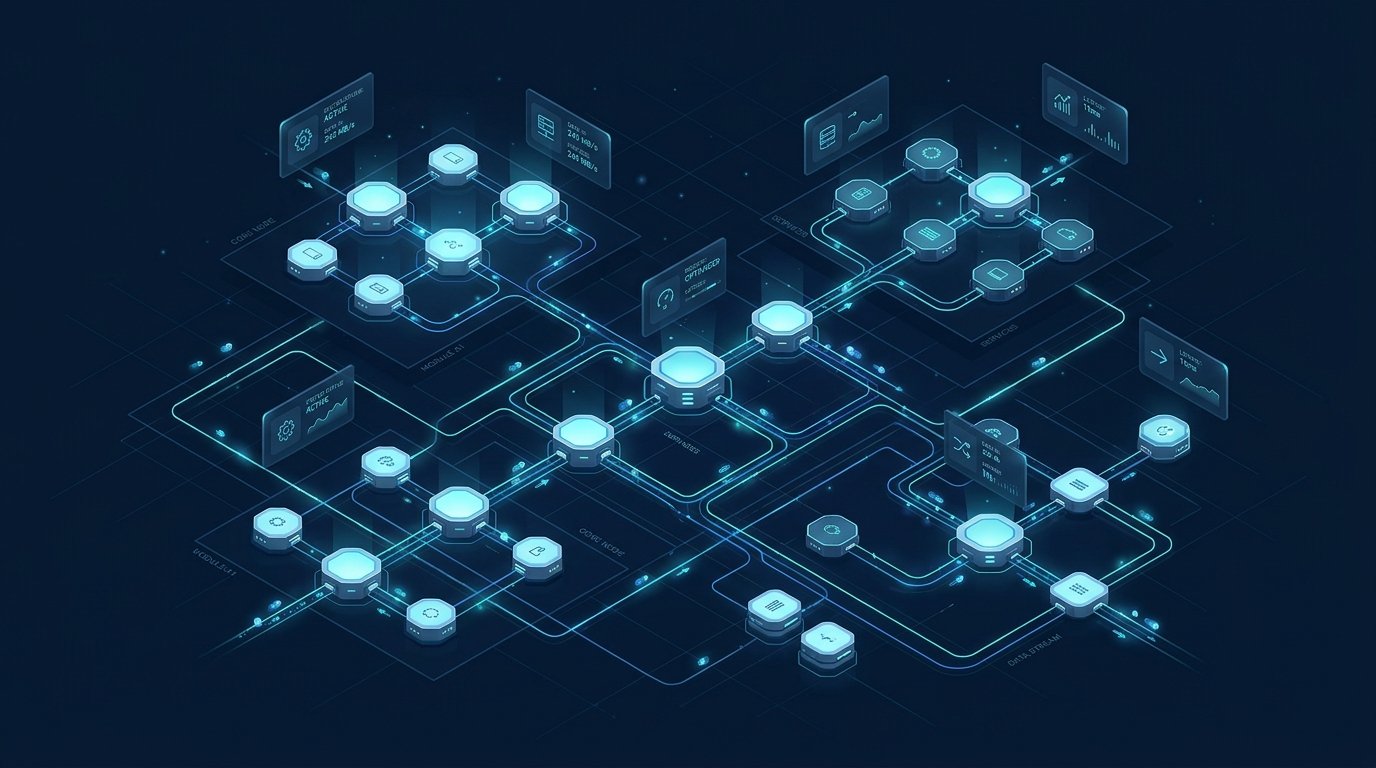
Abstract architectural network showing agentic automation nodes and data pathways
Deterministic · Human-in-the-Loop

WHAT I DO

AI automation built around how work actually gets done.

I’m interested in more than getting an LLM to produce an answer. The useful part is what happens around the model: where the information comes from, what the AI is allowed to decide, what happens next, and when a person needs to stay in control.

Agentic AI & Workflow Automation

I build multi-step workflows that use AI agents, business rules, APIs, and automation platforms to move work across different systems without turning the process into a black box.

RAG & AI-Assisted Operations

I use retrieval to give AI relevant knowledge before it decides. That makes the reasoning easier to inspect and gives the workflow something concrete to work from instead of relying entirely on the model.

Process & Operational Design

My background is in SaaS support operations, so I think about ownership, escalation, exceptions, audit trails, and human review from the beginning. Automation should make a process easier to run, not harder to understand.

FEATURED PROJECTS

Here is what I’ve been building.

These are portfolio projects built in fictional business environments. The companies are fictional, but the workflows are functional builds designed around the operational problems real teams face.

AI Support Operations · RAG · Agentic AI

Sendex AI Support Escalation System

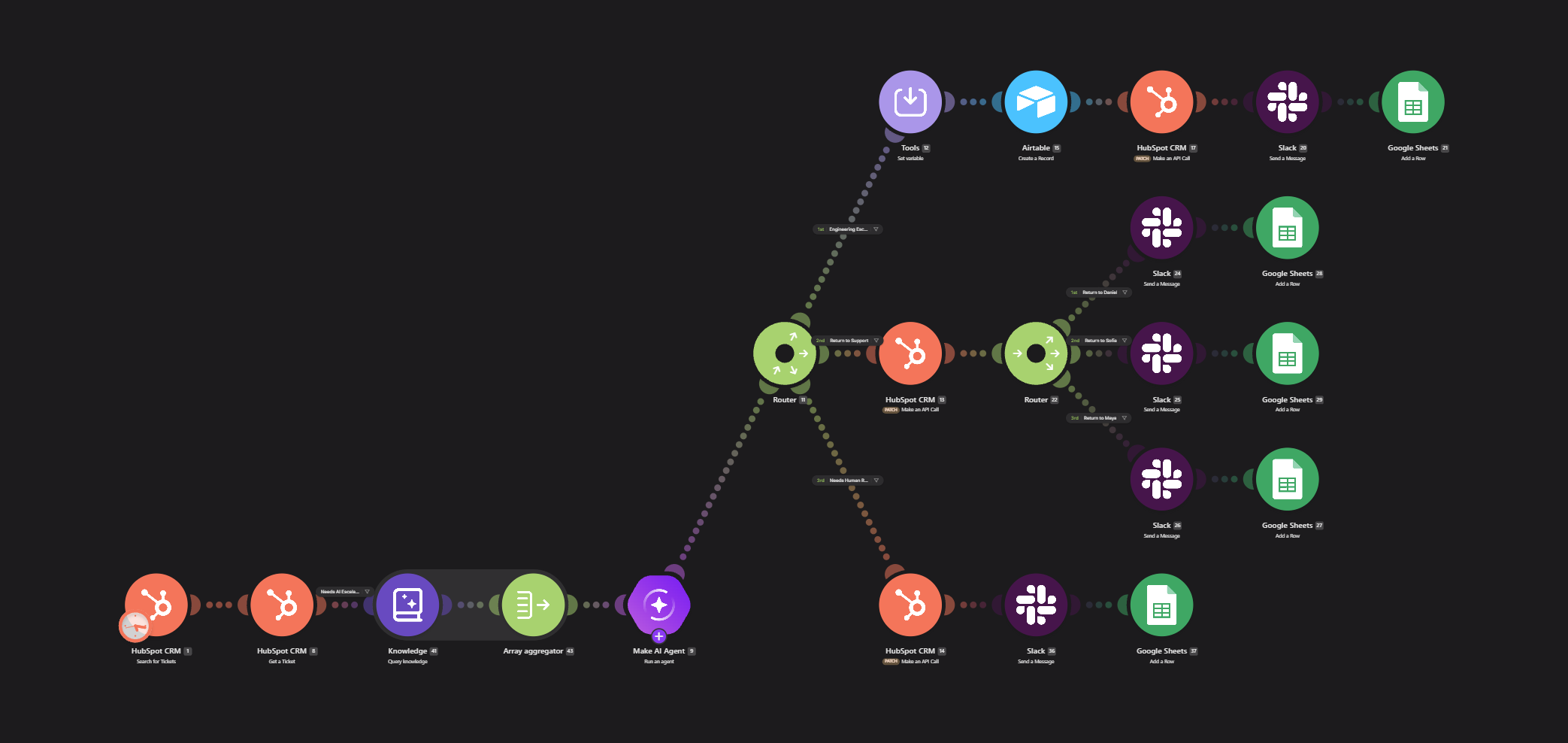
A RAG-grounded support escalation workflow that decides whether a ticket should return to frontline support, move to Engineering, or go to Senior Support for human review.

The workflow starts in HubSpot, retrieves relevant support knowledge before the AI Agent reasons about the ticket, and returns a structured decision with confidence, impact, recommended action, and known-issue context.

Make then controls what happens next. Valid Engineering escalations create a tracked Airtable issue. Ambiguous cases go to Senior Support. Tickets that don’t need Engineering are returned to Support with troubleshooting guidance on what should happen next.

Every outcome is written back to HubSpot, routed through Slack, and logged in Google Sheets.

RAG first. Agent reasoning second.

The retrieval stage is explicit and testable. Knowledge is retrieved and combined before the AI Agent runs, which makes it possible to inspect the evidence separately from the model’s decision.

Project highlights:

  • 5 controlled validation cases
  • 3 routing outcomes
  • Explicit RAG knowledge retrieval
  • Positive and negative known-issue matching tested
Evaluation note: The final validation exercised Return to Support, Engineering, and Human Review. These were portfolio-scale tests, not production benchmarks.
Technology: Make · HubSpot · Make Knowledge / RAG · Airtable · Slack · Google Sheets
Sendex AI Support Escalation System Make scenario workflow interface

Click image to inspect Make & RAG architecture
AI Support Operations · Classification · Human-in-the-Loop

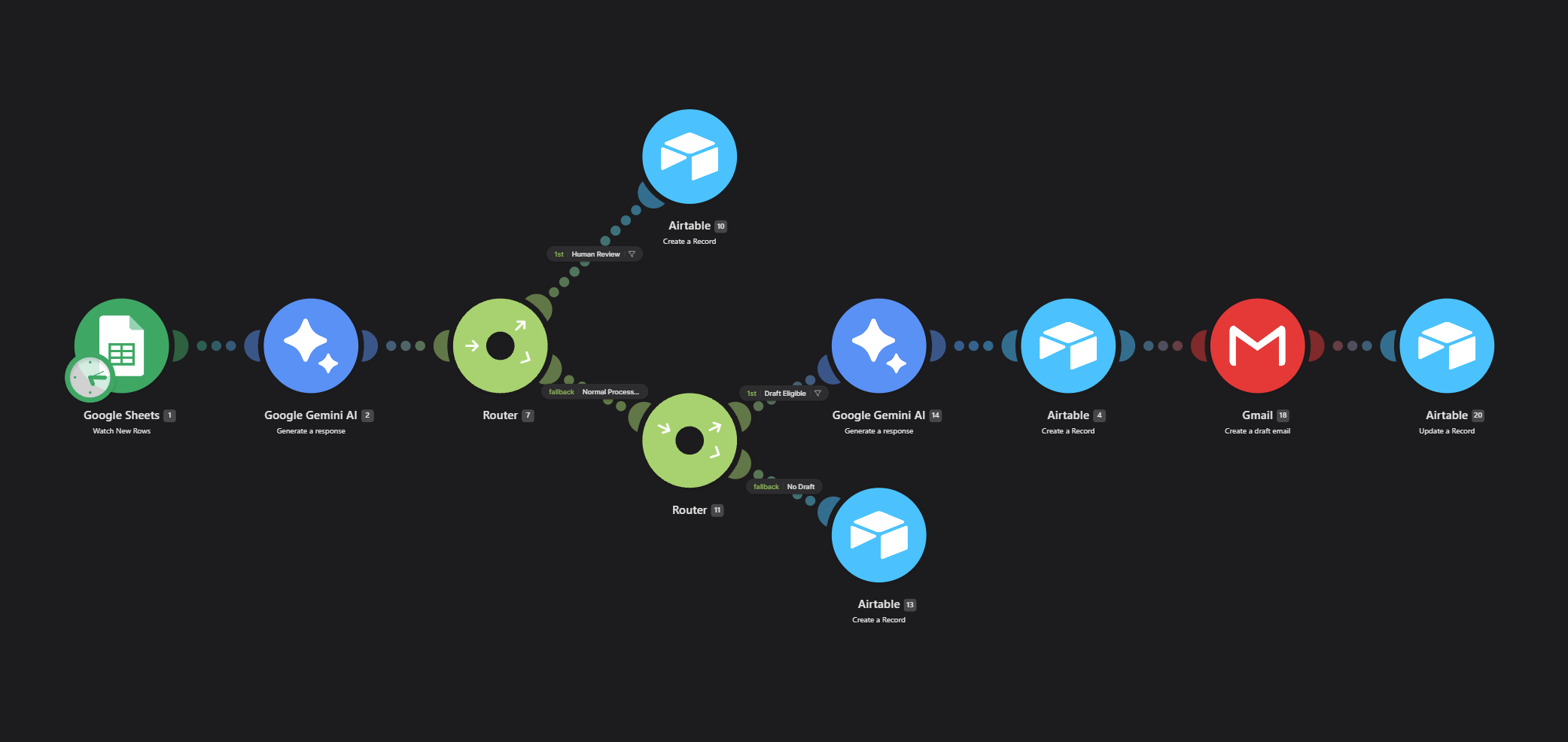
CampaignPilot Support Operations

An AI-assisted support workflow for ticket classification, risk-aware routing, response drafting, and operational visibility.

Gemini classifies incoming support tickets into a structured format that includes category, subcategory, priority, queue, sentiment, confidence, risk flags, and a summary.

The AI provides context, but it doesn’t control the final operational decision. Make applies explicit rules around security, billing, cancellations, data loss, low confidence, severity, and emotionally escalated cases.

Eligible responses become Gmail drafts for review instead of being automatically sent to the customer.

AI where it helps. Rules where they matter.

A model can be wrong about subjective things such as sentiment or severity. The workflow keeps those judgments separate from the rules that decide whether something should proceed automatically or be reviewed by a person.

Project highlights:

  • 12 controlled test cases
  • 100% category accuracy in the test set
  • 100% queue accuracy in the test set
  • 100% risk flag and human-review behavior in the test set
  • Human-in-the-loop response drafting
Evaluation note: Priority reached 75% and sentiment 66.7% in the controlled evaluation. Those results are useful because they show where the model was strong and where subjective judgment created more variation. They should not be presented as production-scale model performance.
Technology: Google Sheets · Google Gemini · Make · Airtable · Gmail
CampaignPilot Support Operations triage interface and risk-aware pipeline

Click image to inspect classification & draft queue

AI Workflow Automation · Revenue Operations

Vantrell Systems AI Lead Operations

An end-to-end lead operations workflow that combines AI qualification with deterministic validation, territory assignment, CRM actions, human review, and audit logging.

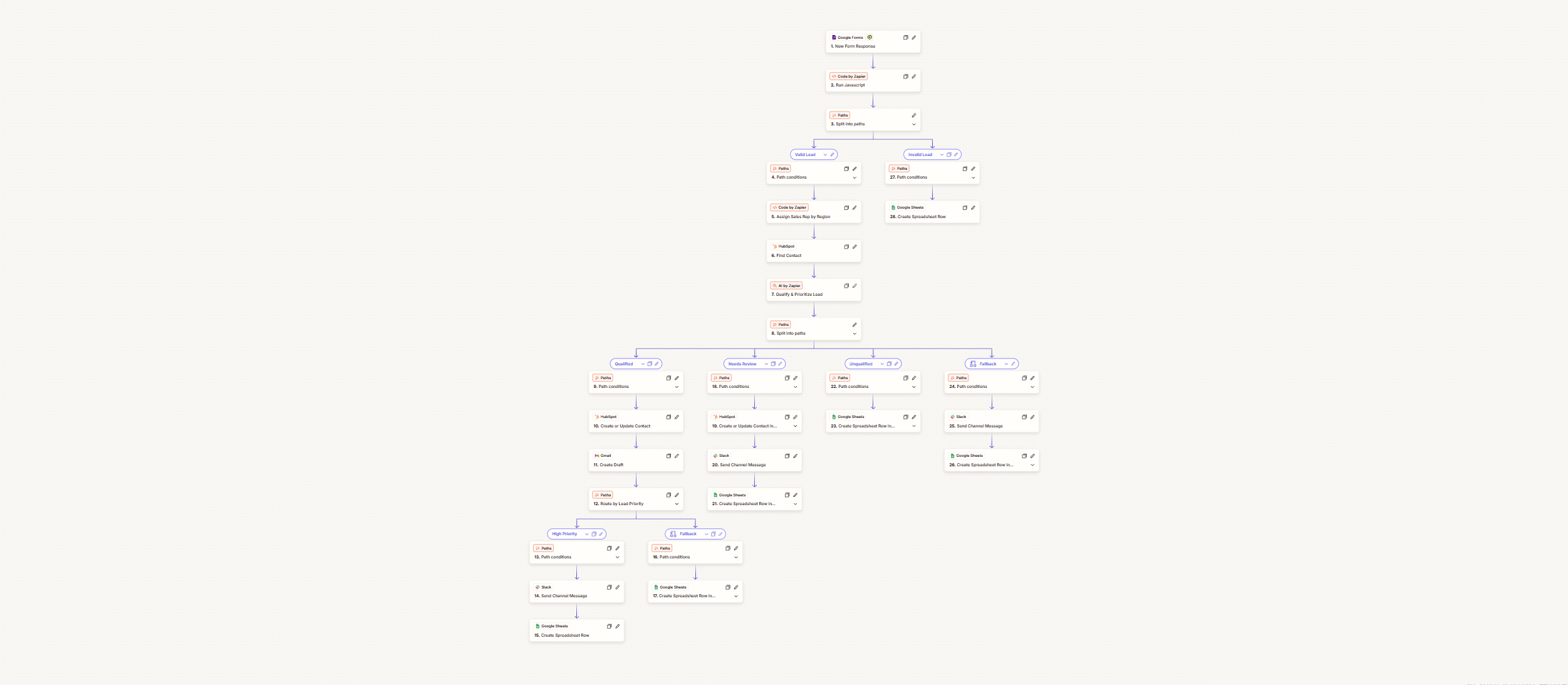
Zapier validates and cleans incoming lead data, assigns the correct sales territory using explicit code, checks HubSpot, and then uses AI to classify the lead’s intent, priority, qualification status, confidence, and recommended next action.

The workflow has separate outcomes for qualified leads, leads that need review, unqualified leads, invalid input, and unexpected AI output.

Customer follow-up is prepared as a Gmail draft instead of being automatically sent.

Probabilistic classification. Deterministic execution.

The AI can help interpret the lead, but it doesn’t decide territory ownership, validation requirements, or which downstream actions are allowed. Those rules remain explicit and reviewable.

Project highlights:

  • 5/5 controlled functional tests passed
  • 3/3 sales territories verified
  • 3 AI qualification routes verified
  • 2 priority routes verified
  • One centralized Run Log record per terminal execution
Evaluation note: The evaluation covered CRM updates, Gmail drafting, Slack escalation, invalid input handling, territory routing, and audit logging. These results represent the tested portfolio workflow, not production-scale model accuracy.
Technology: Zapier · AI by Zapier · HubSpot · Google Forms · Gmail · Slack · Google Sheets
Vantrell Systems AI Lead Operations pipeline in Zapier with territory branches

Click image to inspect Zapier workflow & run log

Agentic AI · Competitive Intelligence · Multi-App Orchestration

RivalScope Strategy — Agentic Competitive Intelligence

An agentic workflow that researches the live web, compares potential competitors, selects one primary competitor, structures the findings, preserves the evidence, and prepares a client-ready analysis.

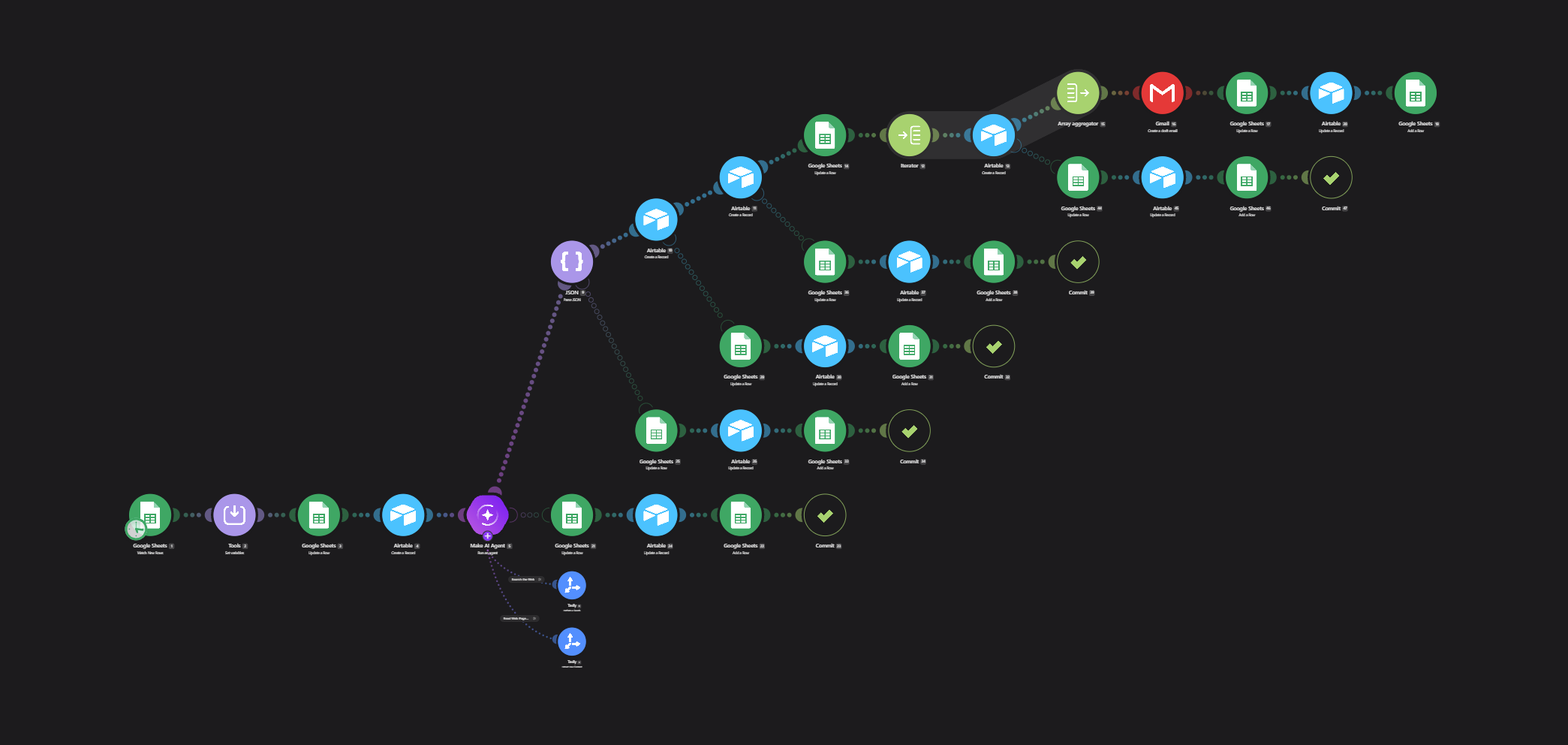
A client intake form provides the business context the agent needs before it begins research. The Make AI Agent can search the web with Tavily, inspect pages, compare candidates, and deepen its research before returning a structured result.

The agent controls how it researches. It does not get unrestricted control over everything that happens afterward.

Strict JSON parsing, deterministic Airtable writes, evidence records, Gmail draft-only communication, run logging, and explicit error handling control the operational side of the workflow.

Autonomous tool use. Controlled output.

The agent can gather evidence, but it can’t invent fields, silently write unsupported information into operational systems, or send client communication on its own.

Project highlights:

  • 2 successful end-to-end validation runs
  • 1 deliberate malformed-JSON failure test
  • 5 critical failure points instrumented
  • 1 terminal log record per execution
  • Structured source evidence linked to each analysis
Evaluation note: The deliberate failure test confirmed that malformed AI output could be surfaced and stopped before incomplete database records or client communication were created.
Technology: Google Forms · Make · Make AI Agent · Tavily · Airtable · Gmail · Google Sheets
RivalScope Strategy Make AI Agent canvas with Tavily search and Airtable evidence

Click image to inspect Make AI Agent & Tavily tools

Jerry J. Hudson

Agentic AI Automation Architect

Petawawa, ON

ABOUT ME

My background is why I build automation this way.

I didn’t start in AI. I spent 13 years working in SaaS support, eventually moving from frontline technical support into team leadership and senior technical support.

That meant dealing with what happens when a process doesn’t work well: tickets going to the wrong place, Engineering getting incomplete escalations, customers waiting for answers, documentation falling behind, and support teams doing repetitive work that should have been easier.

At Ziff Davis, I worked across technical support, escalations, documentation, training, quality assurance, and process improvement. In my final Senior Technical Specialist role, a redesigned support-ticket triage process reduced resolution time by 82% and improved CSAT by 5%.

That experience shapes how I approach AI automation now.

I’m not interested in adding AI to a workflow simply because it can generate text. I want to know what problem it is solving, what information it needs, what it should be allowed to decide, and what happens when it gets something wrong.

That’s why the systems I build tend to combine AI with structured data, deterministic rules, human review, and logging.

The AI is part of the workflow. It isn’t the whole workflow.

Certifications & Training

I’ve been building on my operations background with training focused on AI, automation, agents, prompting, and the platforms I use in my projects.

Certified Zapier Expert badge placeholder
Credential

Certified Zapier Expert

AI Builder & Model Context Protocol

Zapier · 2026
AI Agent Builder badge placeholder
Credential

AI Agent Builder

Make Academy · 2026
AI Automation Explorer badge placeholder
Credential

AI Automation Explorer

Make Academy · 2026
AI Essentials badge placeholder
Credential

AI Essentials

Google · 2026
Prompting Essentials badge placeholder
Credential

Prompting Essentials

Google · 2026
Agentic AI Training badge placeholder
Credential

Agentic AI Training

Great Learning · 2026

Awards & Recognition

Before moving into AI automation, I spent years working in customer support and service operations. These team awards are part of that background.

Stevie Awards placeholder
Award

Stevie Awards

Customer Service Excellence

Team Award · 2014–2018
ORCCA Platinum Award of Excellence placeholder
Award

ORCCA Platinum Award of Excellence

Service Excellence · Teamwork · Performance

2015 & 2018

SKILLS & TOOLS

The tools change. The design principles don’t.

Most of my projects involve several applications working together. I focus on understanding what each part of the workflow should do, then use the right tool for the job.

Automation & Orchestration

  • Make
  • Zapier
  • N8N
  • Multi-app workflow design
  • Workflow routing and branch logic
  • Human-in-the-loop workflows
  • Error handling
  • Audit logging

AI & Knowledge

  • AI Agents
  • LLM workflows
  • RAG and knowledge retrieval
  • Prompt engineering
  • Structured AI output
  • AI evaluation and testing

Platforms & Business Systems

  • HubSpot
  • Airtable
  • Slack
  • Gmail
  • Google Sheets
  • Google Forms
  • Tavily

Operations

  • SaaS Support Operations
  • Support-to-Engineering Escalations
  • Workflow Design
  • Process Mapping
  • Business Process Improvement
  • Knowledge Management
  • Technical Troubleshooting

AI should make a process easier to run, not harder to trust.

A model can classify something, summarize it, or recommend an action. That doesn’t mean it should automatically control everything that happens afterward.

The projects in this portfolio use AI where judgment and language are useful, but important operational decisions stay explicit. Routing rules can be reviewed. Sensitive actions can require a person. Errors can be traced. Outputs can be tested.

That’s the kind of AI automation I want to build.

CONTACT

Want to talk about AI automation?

I’m currently focused on opportunities involving AI workflow automation, agentic systems, SaaS operations, and technical implementation.

If you’re hiring for this kind of work, tackling an automation problem, or want to talk about a project in my portfolio, feel free to reach out.

You can also find me on LinkedIn, GitHub, and X.